Consumer Reports 2025 named who failed
Twenty fish oils tested between January and May 2025. Kirkland Signature, Nature Made Burp-Less and California Gold Kids failed on rancidity. Qunol Ultra held only 83% of its declared EPA. Nearly half the samples carried traces of lead, and every one of them traces of dioxins and PCBs: below their limits, but all of them.
Source Consumer Reports
Grade Hard source. Named brands, recent date.
Half the shelf over the oxidation limit
Jackowski and colleagues measured 171 supplements from 49 brands sold in Canadian shops. 50% were over the voluntary limit on at least one oxidation measure, and 39% over total oxidation (TOTOX). A further 18% were close to the limits, with one to three years still to run before expiry.
Source Journal of Nutritional Science
Grade Peer-reviewed study.
A 3.8-fold difference behind almost the same number on the front
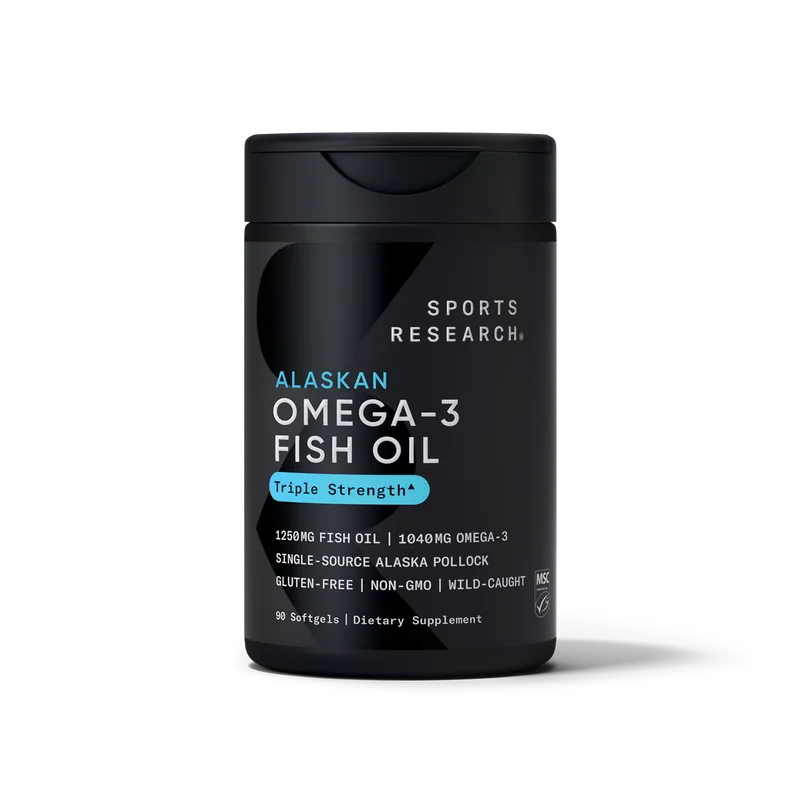
Nature Made says 1000 mg on the front and delivers 250 mg of EPA+DHA per capsule. Sports Research says 1250 mg and delivers 950. The numbers on the front differ by a quarter; the contents differ 3.8 times. For the EFSA daily dose you need one capsule. Or four.
Source Nature Made label · IFOS certificate, Sports Research
Grade From the labels.
Chia and flax will not give you DHA, and men least of all
Conversion of ALA to EPA comes out under 8%, and to DHA under 4%. Split by sex it is harsher: women 21% to EPA and 9% to DHA, men 8% and 0%. Four weeks of 10.7 g of ALA a day from flaxseed oil did not raise DHA in breast milk at all.
Source Burdge & Wootton, re-analysis · Overview
Grade Peer-reviewed.
The salmon you buy is not the salmon of 2006
Over 3000 Scottish farmed salmon measured between 2006 and 2015: EPA and DHA in the fillet fell by more than half, because the fish oil in the feed was replaced by plant oils. For the same omega-3 intake you now need double the portion.
Source Scientific Reports
Grade Peer-reviewed study.
Freshness limits are not law
The PV, AV and TOTOX values the whole argument rests on are a voluntary industry standard set by GOED, not a regulation. And the FDA neither approves nor tests supplements before they go on sale; a company need not prove anything in advance. That is why freshness is not on the label: nobody has to put it there.
Source PLOS One, 2020 · FDA on dietary supplements
Grade Hard source.
More is not better: above 1.5 g, atrial fibrillation risk rises
A meta-analysis of 34 studies and 114,326 people: in patients at cardiovascular risk taking more than 1500 mg of EPA+DHA a day, the risk of atrial fibrillation rose, odds ratio 1.48. In the other three groups there was no significant finding. Elsewhere: 1000 mg roughly +12%, 1800 to 4000 mg around +50%.
This does not mean "omega-3 raises the risk of atrial fibrillation". The finding holds for high doses in patients at cardiovascular risk. A biomarker meta-analysis of 17 cohorts conversely found a lower incidence of atrial fibrillation at higher blood levels of omega-3. The exact sentence is: above 1.5 g a day, in a cardiac patient.
Source Meta-analysis, 2025
Grade Peer-reviewed.
The biggest trial did not show what everyone expected
VITAL, 25,871 participants, 1 g of omega-3 a day. Primary cardiovascular endpoint: 386 events against 419 on placebo, an 8% difference, not statistically significant. Among the secondary results heart attacks were 28% lower, but the main question did not get its answer.
Source NEJM, 2018
Grade Hard source.
The certificate almost nobody has
IFOS is the only certification programme built exclusively for fish oil. It tests by batch and publishes the full measured values, not just pass or fail. A little over 200 brands worldwide are certified. On the shelf, a minority of bottles will let you see the numbers.
What share that is of the bottles a shopper can actually buy, nobody publishes.
Source IFOS, Nutrasource
Grade Caution: the brand count comes from the programme's operator.
The girl who could not walk
1982: a six-year-old girl after a gunshot wound to the abdomen. Five months on artificial feeding whose fat came from safflower oil, which is practically free of omega-3. What followed were episodes of numbness, tingling, weakness, leg pain, blurred vision and an inability to walk. When linolenic acid was added to her feed, the neurological problems disappeared. The first described case of omega-3 deficiency in a human.
The described cases are people on artificial or tube feeding. The NIH states that classic essential fatty acid deficiency is practically nonexistent in a healthy person in a developed country, and omega-3 deficiency very rare.
Caveat source NIH Office of Dietary Supplements
Source Holman, Journal of Nutrition
Grade Peer-reviewed.
When it runs short, the body builds a substitute membrane
When essential fatty acids run out, the body does not stop building: it fits mead acid into its membranes as a substitute material. That is how the deficiency is measured: a triene-to-tetraene ratio (mead acid to arachidonic acid) above 0.2 is the biochemical definition of essential fatty acid deficiency. Clinically it shows as scaly skin, hair loss, brittle nails and poor wound healing.
The described cases are people on artificial or tube feeding. The NIH states that classic essential fatty acid deficiency is practically nonexistent in a healthy person in a developed country, and omega-3 deficiency very rare.
Caveat source NIH Office of Dietary Supplements
Source Merck Manual · JPEN, 2015
Grade Hard source.